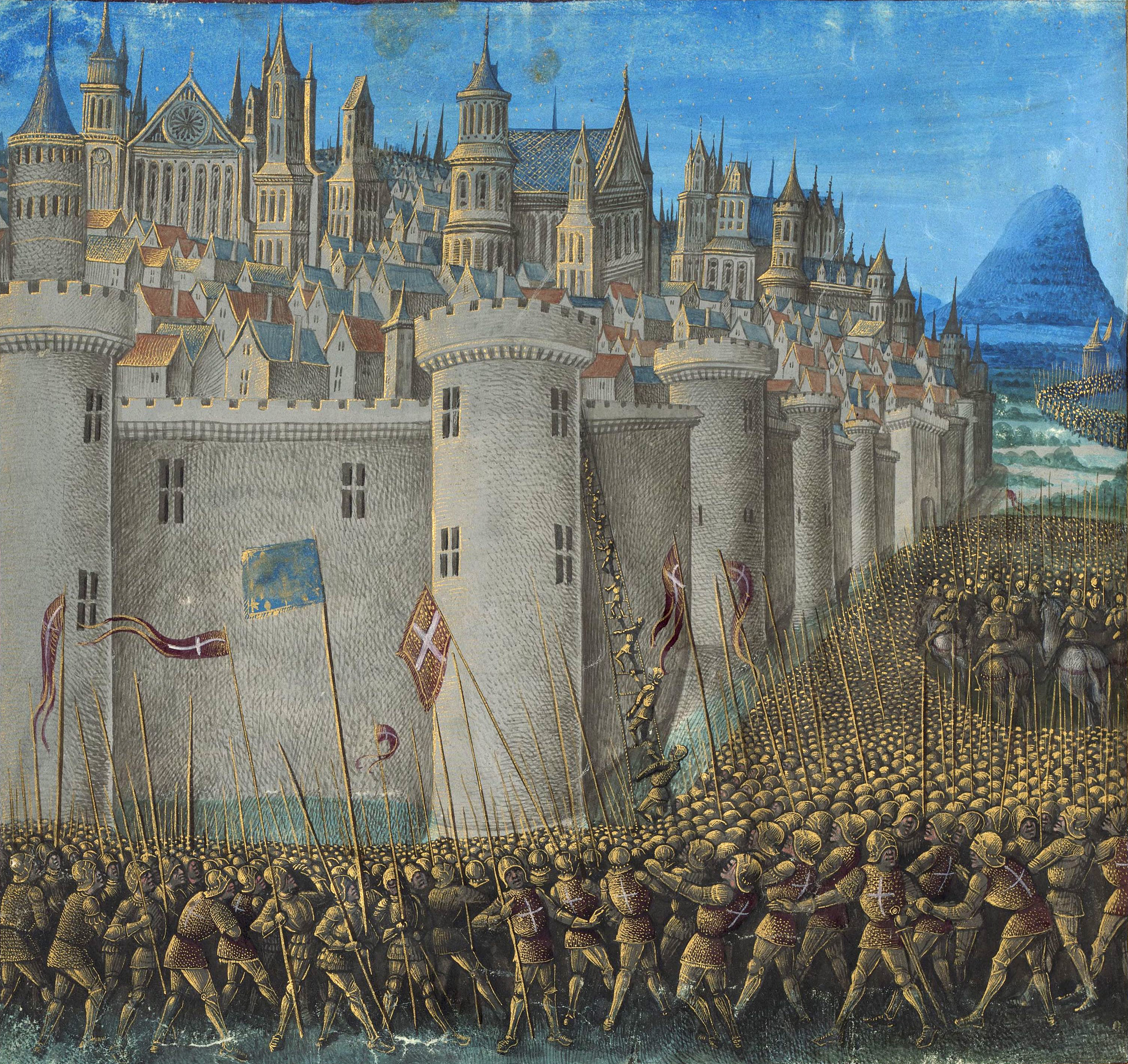
THE FIRST CRUSADE
* When Pope Gregory VII to be the idea that Christian countries unite to fight the common enemy was Islam religious.
* Pope Urban II (1088-1099) was the one who put into practice. In 1095, the invitation to the fight against the Turks would arrive in French and British embassies to the courts of the most important medieval European nations: France, England, Germany and Hungary (Hungary will not join the first crusades to save the grief of 3 years of the late King St. Ladislaus I of Hungary (1046-1095), who before his death would have agreed to participate in the campaign of Urban II). The formal appeal of Urban II it happened on the penultimate day of the Council of Clermont (France), Thursday, November 27, 1095, proclaimed with the cry of '"I volti Dieu"' (God willing!), known as the First Crusade (1096-1099) .
The passage of the Crusaders by the Kingdom of Hungary
Urban II's preaching began in the first place many poor people, led by the preacher Peter the Hermit of Amiens and some French knights. This group formed the Popular Crusade, the poor or Crusade of Peter the Hermit. So disorganized they headed East, provoking massacres of Jews in their wake. In March of 1096 the armies of King Kálmán Hungary (nephew of the late King St. Ladislaus I of Hungary) repelirían the French knights who entered Valter Gauthier Hungarian territory causing numerous robberies and killings near the town of Zimony. Later come the army of Peter of Amiens, which would be escorted by Hungarian forces Kálmán. However, after the Crusaders attacked Amiens escort soldiers and killed at about 4000 Hungarians, the armies of King Kálmán would set a hostile position against the crusaders who crossed the kingdom through Byzantium.
Despite the chaos caused Kálmán allowed entry to the hosts Volkmar cross and Gottschalk, who eventually also had to confront and defeat near Nitra and Zimony, after like the other groups cause untold havoc and murder. In the case of the German priest Gottschalk, he went on Hungarian soil without authorization from the king and set up camp nearby settlement of Táplány after massacring the local population, sparking the wrath of Kálmán, and caused the expulsion through the force of the Teutonic soldiers "invaders."
After this, the Hungarian Count dentendrían Emiko forces (who had killed on German soil to about 4000 Jews) near the town of Moson. Kálmán immediately banned Emiko stay in Hungary and then was forced to confront the siege of the city aristocrat of Moson, where he was the king of Hungary. Kálmán forces bravely defended the city and breaking the site managed to disperse the forces of the count cross-Germanic.
Soon, the Hungarian King Godfrey of Bouillon forced to sign a treaty Pannonhalma Abbey, where the Crusaders were committed to passing through the territory of Hungary with good behavior. After that, the forces would continue outside Hungarian territory, escorted by the armies of Kálmán and continue Constantinople. On arrival in Byzantium, the Basileus was quick to send them across the Bosphorus. Idly penetrated into Turkish territory, where they were easily destroyed.
[edit] The Princes 'Crusade
Much more organized was the Princes' Crusade (commonly known in historiography as the First Crusade) by August 1096, consists of a series of armed troops, mainly from France, Netherlands and the Norman kingdom of Sicily. These groups were led by younger sons of the nobility, as Godfrey of Bouillon, Raymond of Toulouse and Bohemond of Taranto.
During his stay in Constantinople these leaders vowed to return to the Byzantine Empire it lost those territories against the Turks. From Byzantium went to Syria through the Seljuk territory, where they got a series of surprising victories. Once in Syria, laid siege to Antioch, who conquered after a siege of seven months. However, not returned to the Byzantine Empire, but retained it for himself Bohemond forming the Principality of Antioch.
went from Antioch to Jerusalem, gaining a few places along the way and dodging others. In June 1099 they besieged the capital, fell to the Crusaders on July 15, 1099. In the conquest, the Crusaders made a terrible slaughter, that did not respect Jews and Muslims, women and children.
With this victory ended the First Crusade, and many crusaders returned to their countries of origin. The rest was left to consolidate the newly conquered territories. Next to the Kingdom of Jerusalem (led initially by Godfrey of Bouillon, who took the title Defender of the Holy Sepulchre) and the principality of Antioch, also created the counties of Edessa (now Urfa, Turkey) and Tripoli (in modern Lebanon .)
After these initial successes came a new wave of crusaders, who formed the so-called crusade of 1101. However, this expedition, divided into three groups was defeated by the Turks as they passed through Anatolia. The accident shut down the spirits crossed for some years.

SECOND CROSS
Thanks to the division of Muslim states, the Latin states (or Franks, as they were known to the Arabs), managed to establish themselves and survive. The first two kings of Jerusalem, Baldwin I Baldwin II were rulers and able to spread the kingdom to all the land between the Mediterranean and the Jordan, and beyond. Quickly integrated into the evolving system of local partnerships and thus could be clashes between the alliance of a Christian state with one Muslim against another State Christian alliance with another Muslim state.
However, as the crusading spirit was waning among the Franks, more and more comfortable in their new style of oriental life, among Muslims was growing the spirit of jihad or holy war, especially among the population, mobilized by preachers against their wicked rulers, able to tolerate the Christian presence in Jerusalem and even siding with their kings. This sentiment was exploited by a number of leaders who succeeded in unifying the various Muslim states and out to conquer the Christian kingdoms.
The first of these was Zengi, Governor Mosul and Aleppo, which conquered Edessa in 1144, settling the first of the Frankish states. In response to this conquest, which highlighted the weakness of the Crusader states, Pope Eugene III, through Bernard, Abbot of Clairvaux (famous preacher, who also created the rule of the Templars) preached in December 1145, the Second Crusade.
Unlike the first in this part of the Christian kings, led by Louis VII of France (with his wife, Eleanor of Aquitaine) and the Holy Roman Emperor Conrad III. The disagreements between the French and German, as well as the Byzantines, were constant throughout the expedition. When the two kings came to the Holy Land (Separately) decided that Edessa was a minor objective and marched to Jerusalem. From there, to the despair of King Baldwin III, instead of dealing with Nur al-Din (son and successor Zengi), chose to attack Damascus, independent state and ally of the king of Jerusalem. The expedition was a failure because after only a week of fruitless siege, the Crusader armies withdrew and returned to their homelands. With this attack useless managed Damascus fell to Nur al-Din, which was gradually encircling the French state. Later, the attack by Baldwin II to Egypt would provoke the intervention of Nur al-Din on the southern border of the kingdom of Jerusalem, preparing the way to the end of the kingdom and the convening of the Third Crusade.

THIRD CRUSADE
The interference of the Kingdom of Jerusalem in the decadent Fatimid Caliphate in Egypt led to the Sultan Nur al-Din to Saladin sent his deputy to take charge of the situation. It did not take long for Saladin became the master of Egypt, even to the death of Nur al-Din in 1174 to respect the sovereignty of the latter. But after his death, Saladin proclaimed himself sultan of Egypt (though he had an heir to the throne of Nur al-Din, the son of 12 years and who eventually was poisoned) and Syria kicking off the Ayyubid dynasty. Saladin was a wise man and got the absolute unity of the Muslim factions and the political and military control from Egypt to Syria.
As Nur al-Din, Saladin was a devout Muslim and decided to expel the crusaders from the Holy Land. The Kingdom of Jerusalem, ruled by the Leper King Baldwin IV of Jerusalem, surrounded by a single state and was forced to sign skirmishes followed by fragile truces, trying to delay the inevitable end.
After the death of King Baldwin IV of Jerusalem, the State was divided into various factions, pacifist or bellicose, and went on to become king because of the marital bond he maintained with the sister of the late patriarch, the commanding general of the united army of Jerusalem, Guy de Lusignan. The same support an aggressive policy of not negotiating with the Saracens and called for their surrender and defeat in battle, something to which critics opposed the view that Christians outnumbered troops had to Saladin. The religious radicalism and support for the radical arm of the Order of the Templars in their attacks on several towns and Saracen structures, culminating in a final showdown between Guy de Lusignan and Saladin himself. In fact, he is guilty of Guy de Lusignan of defeat and loss of Jerusalem by his obsession to confront the army of Saladin and his lack of vision for the protection of the city and its inhabitants.
Krak des Chevaliers. This fort was considered impregnable, controlled the interior of Syria over the coast and was under the command of the Knights Hospitallers until 1271, when they lost the Christian territories, they were allowed out of his knights to Cyprus. Reynald of Châtillon
was a bandit with a knighthood which was not considered bound by the truce signed. Pillaged caravans and even pirates armed expeditions to attack ships pilgrims to Mecca, very important city to Muslims. The final attack was on a convoy in which he was the sister Saladin, who vowed to kill him with his own hands.
declared war, the bulk of the crusader army, together with the Templars and Hospitallers, faced the troops of Saladin at the Horns of Hattin on July 4, 1187. Christian armies were defeated, leaving the kingdom defenseless and losing one of the fragments of the True Cross. Saladin killed with his own hands to Reynald of Châtillon. Some of the Knights Templar and Hospitallers captured were also executed. Saladin proceeded to occupy most of the kingdom, except the coastal places, supplied from the sea, and in October the same year he conquered Jerusalem. Compared with the capture of 1099, this was almost bloodless, although its inhabitants had to pay a considerable ransom and some were enslaved. The kingdom of Jerusalem had disappeared.
The capture of Jerusalem shook Europe and Pope Gregory VIII called for a new crusade in 1189. In this part of the most important kings of Christendom: Richard the Lionheart (son of Henry II and Eleanor of Aquitaine), Philip II Augustus of France and Emperor Frederick I Barbarossa (nephew of Conrad III). The latter, commanded the most powerful group, followed the land route, which suffered some casualties. About Syria, however, the Emperor was drowned while bathing in the river SALEF (in Turkey) and his army did not continue to Palestine. Barbarossa during their stay in the Kingdom of Hungary had asked the Prince Géza, brother of King Béla III of Hungary would join the crusading forces and an army of 2,000 soldiers left Hungarian side of the Germans. While armed conflicts after the Hungarian king had called back its forces, his younger brother, Géza, remained in Constantinople and married a Byzantine noble, since it had good relations with Béla III.
English and French armies arrived by sea route. His first (and only) success was the taking of Acre on July 13, 1191, after which Richard made a massacre of several thousand prisoners. This massacre military gave oxygen to continue south to their ultimate goal: Jerusalem, and also earned him the name by which he would be recognized in history, Lion Heart.
Philip II Augustus was concerned about problems at home and upset about the rivalry with Richard, and he returned to France, leaving Richard in control of the crusade. This came to the vicinity of Jerusalem, but chose instead to strike a truce with Saladin, fearing that decimated his army of 12,000 men were not able to sustain the siege of Jerusalem. Thinking about an upcoming cross and not to risk a military defeat would not give Christians the possibility of a subsequent check of the Holy City, agreed with Saladin himself, who was also tired and depleted, the truce that allowed free access unarmed pilgrims to the Holy City.
Saladin died six months later. Richard died in 1199 by an arrow on his return to Europe. Thus, the Third Crusade was closed with another failure for the two sides, leaving no hope for the French state. It was a matter of time for the disappearance of the narrow coastal strip they controlled. However, even withstood a century.

FOURTH CRUSADE
after the ceasefire signed in the Third Crusade and Saladin's death in 1193, it happened a few years of relative peace, in which the Frankish states of the coast became little more than Italian commercial colonies . In 1199, Pope Innocent III decided to convene a new crusade to alleviate the plight of the Crusader states. This Fourth Crusade should not include kings and go directed against Egypt, considered the weakest point of the Muslim states.
No longer can the land route, the Crusaders had taken the sea route, so focused in Venice. The Doge Enrico Dandolo entered into partnership with the chief the issue of Montferrat Boniface and a Byzantine usurper, Alexius IV Angelus to change the fate of the cross and direct it against Constantinople, being the three parties in the deposition of basileus the time, Alexius III Angelus.
Initially, the Crusaders were employed to fight the Hungarians in Zara, so they were excommunicated by the Pope. From there they went to Byzantium, where they could install Alexius IV as Basileus in 1203. However, the new basileus could not fulfill its promises to the Crusaders, which led to all sorts of disturbances. He was deposed by the Byzantines themselves, which crowned Alexius V Ducas. This ultimately led to intervention of the Crusaders, who conquered the city on April 12, 1204. The sacking of the city was terrible. Thousands of Christians (including women and children) were killed by the Crusaders. Looted and destroyed houses, palaces, churches and the Basilica of St. Sophia itself. Western Europe received a flood of works of art and relics unprecedented result of the looting.
This came to an end the Byzantine Empire, which fell apart in a number of countries, some Latin and other Greeks. Of these, the so-called Empire of Nicea get restore a shadow of the Byzantine Empire in 1261.
called The Crusaders established the Latin Empire, organized and an authority feudally very weak on most of the territories that allegedly controlled (and zero on the Greek states of Nicaea, Trebizond and Epirus). The Fourth Crusade
dealt a double blow to the French State of Palestine. On the one hand, deprived them of military reinforcements. On the other, creating a magnet for men in Constantinople Latin was the emigration of many who were in the Holy Land to the Latin Empire, leaving the French State.

FIFTH CROSS
The V Crusade was proclaimed by Pope Innocent III in 1213 and left in 1218 under the auspices of Honorius III, joining the Crusader King Andrew II of Hungary, who was to guide the largest army in the entire history of the Crusades. As the Fourth Crusade, was to conquer Egypt. After the initial success of the conquest of Damietta at the mouth of the Nile, which ensured the survival of the French State, the Crusaders were able to ambition and tried to attack Cairo, failing and should abandon even what they had conquered in 1221. SIXTH CROSS
The organization of the Sixth Crusade was a bit farfetched. The pope had ordered the Emperor Frederick II who went to the cross as penance. The emperor had accepted, but the game had been delayed, which earned him excommunication. Finally, Federico II (which had its own claim on the throne of Jerusalem) left in 1228 without papal permission. Surprisingly, the emperor managed to recover Jerusalem through a diplomatic settlement. He declared himself king of Jerusalem in 1229 and also won Bethlehem and Nazareth. SEVENTH CROSS
In 1244 Jerusalem fell again (this time permanently), prompting the devout King Louis IX of France (St. Louis) to organize a new crusade, the Seventh. As in the V, was directed against Damietta, but was defeated and taken prisoner in Mansoura (Egypt) and all his army. EIGHTH CROSS
return to France, the king undertook the Eighth Crusade call (1269) against Tunisia, but in reality was a pawn in the interests of his brother Charles of Anjou king of Naples, who wanted to avoid competition Tunisian merchants. The plague ended with King Louis and much of his army in Tunisia (1270).
Although some popes tried to preach new crusades, no more and were organized in 1291, the crusaders evacuated their last possessions in Tyre, Sidon and Beirut after the fall of Acre. After all, the only significant triumph of Christianity for two centuries more than eight cross was the taking of Jerusalem by Godfrey of Bouillon in the First Crusade in 1099, which, despite the countless massacres of Saracens, Jews (men, women and children), managed to hold the Holy City for many years, and found the objectives initially set by proponents of the idea of \u200b\u200bregaining the land called holy to the Christians of Europe.




 The collection was, for example, a nail polish called Juarez and other Factory (factory). Other names: Ghost Town (Ghost Town), Bordertown (border town), Sleepwaker (sleepwalking), Sleepless (Sleepless). The allusions continue, "Kitschmas" a contraction of the words "Christmas" and kitsch-that artistic expression that refers to "lower" or "cheap", or at Monaco, as contemptuously called in Mexico, "" Pale "(pale), Drifting Softly (Softly drifting), Badlands (Westfall, wastelands).


